Students from the University of Georgia and Georgia Southern University have been selected to conduct year-long independent research projects focused on coastal issues as part of Marine Extension and Georgia Sea Grant’s Research Traineeship.
This year’s cohort will investigate pollution and parasitism in the Turtle-Brunswick River Estuary, phytoplankton communities in the Satilla River Estuary, ecological shifts associated with mangrove expansion and the effects of warming waters on striped bass.
Since 2018, the Research Traineeship has supported 49 undergraduate and graduate students from universities across the state, providing hands-on opportunities to address challenges facing Georgia’s coast. Selected projects must align with one or more of Marine Extension and Georgia Sea Grant’s focus areas: healthy coastal ecosystems, sustainable fisheries and aquaculture, resilient communities and economies, and environmental literacy and workforce development.
Students are guided by faculty advisors and collaborate with Marine Extension and Georgia Sea Grant specialists or other professional mentors throughout their research. In addition to conducting independent studies, trainees are encouraged to share their findings with coastal communities.
“This competitive opportunity gives students the chance to lead their own research while building connections with communities and partners, including nonprofits, state agencies and academic institutions also working on the coast,” said Brooke Carney, associate director of research for Marine Extension and Georgia Sea Grant. “Students gain valuable professional experience while conducting research that can inform coastal management and conservation efforts.”
Student projects at a glance:

Adalena Band is a doctoral student in ecology at UGA. She earned a bachelor’s in marine science and international studies from Eckerd College. Advised by UGA ecology professor Jeb Byers, Band’s project will explore how mangroves facilitate the movement of aquatic species as their range extends northward into Georgia.
Mangroves are intertidal plants with distinctive aerial root structures that provide habitat for a variety of marine organisms. Their range is expanding into southern Georgia due to a decline in prolonged freezes. Band’s research will examine if these root systems are facilitating the recruitment of aquatic species at the edge of their range. Her research will provide insight into whether expanding mangrove habitat may promote the northern migration of other subtropical species or alter the dynamics of the marine communities in Georgia’s coastal ecosystems.

Bailey Crane is pursuing a master’s degree in biology at Georgia Southern University under the advisement of Risa Cohen, professor of biology. Crane earned bachelor’s degrees in marine biology and environmental and sustainability studies from the College of Charleston. Her research focuses on how phytoplankton communities respond to salt marsh restoration in the Satilla River Estuary.
Historic cuts through the marsh, originally created to facilitate logging and navigation, altered water flow and salinity in the Satilla River Estuary, likely contributing to declining fish catches. A long-term collaborative restoration effort involving Dover Bluff residents, Augusta University, Georgia Southern University, Francis Marion University and Satilla Riverkeeper has led to the closure of these channels. Crane’s project will characterize phytoplankton abundance and community composition in response to these restoration efforts to determine whether they are improving water quality and supporting the planktonic food sources required for fish growth and development. Her findings will provide insight into how restoration may strengthen estuarine food webs and benefit commercially and recreationally important fish species.


Margaret Staller is also a doctoral student at UGA who is working under the advisement of Byers. She earned her undergraduate degree from Colby College, majoring in biology with concentrations in evolution and ecology and English. Her research examines how pollution and parasitism impact Georgia salt marsh communities.
All organisms are subject to different environmental stressors that shape the structure and robustness of food webs. Staller’s research will examine how pollution and parasitism interact within a salt marsh community in the Turtle-Brunswick River Estuary. Her work focuses on mud snails, which serve as hosts for parasitic flatworms. Both organisms feed on sediment that may contain environmental pollutants. While pollution and parasitism may work synergistically to harm the host snail, pollutants could also negatively affect the parasitic flatworms themselves, potentially reducing their impact. By investigating these interacting stressors and their cascading effects throughout the marine community, Staller’s research will improve understanding of how multiple environmental pressures shape ecosystems and influence responses to environmental change.
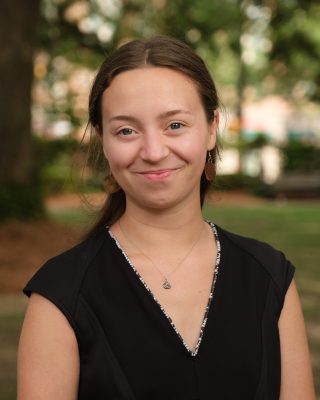
Ryland Talmadge is a master’s student working toward a degree in biology at Georgia Southern University. She is studying the impact of warmer water temperatures on performance and survival of striped bass under the advisement of Johanne Lewis, associate professor of biology at Georgia Southern University. Talmadge has a bachelor’s in marine biology from the College of Charleston.
Striped bass are an ecologically and economically important fish in Georgia, but rising water temperatures continue to challenge their performance and survival. To sustain southern striped bass populations, fisheries managers rely on annual stocking programs that often include hybrid striped bass because they appear to be more heat-tolerant. Talmadge’s research investigates how warming affects the physiology of pure and hybrid striped bass by measuring metabolism, heat tolerance and cellular responses across ecologically relevant temperatures. By comparing the two, Talmadge hopes to identify the underlying mechanisms that influence thermal resilience and inform climate-adaptive stocking strategies.
Marine Extension and Georgia Sea Grant’s Research Traineeship is funded by NOAA’s National Sea Grant College Program. Applications for the 2027-2028 cycle will open in February of 2027. Learn more at https://gacoast.uga.edu/research-traineeship/