On the corkboard above my desk, I have an assortment of reminders of where I’ve come from. In the bottom corner is an identification card for a number of shark teeth, some fossilized, others not; the center holds a printout of the BEETLES (Better Environmental Education Teaching, Learning, and Expertise Sharing) learning cycle; from the top hangs a golden ornament depicting a homesteader on her porch in Jackson Hole, Wyoming. Across my desk are scattered objects accumulated from the last several months of work: a spider crab molt, a whelk egg strand, a stack of Gyotaku prints, an Eastern bird field guide. Most notably, punctuating its end, is a white binder. It contains 49 pages, four interviews, and approximately six months’ worth of research — the culmination of my work here at UGA Marine Extension and Georgia Sea Grant. It is also, hopefully, a reminder of where I am going next.
A newcomer to the state, I had no idea what to expect out of my fellowship when I moved to Skidaway Island in September. Following my graduation from the University of Miami in May of 2024, I had drifted from seasonal position to seasonal position. I was torn between an eventual return to shark feeding ecology research, which I had loved studying for my undergraduate thesis, and staying in STEM education, an interest I had developed through teaching at Teton Science Schools and History Jackson Hole. When I saw the UGA Marine Extension and Georgia Sea Grant Marine Education Fellow position, I jumped at the chance to combine both of my passions.
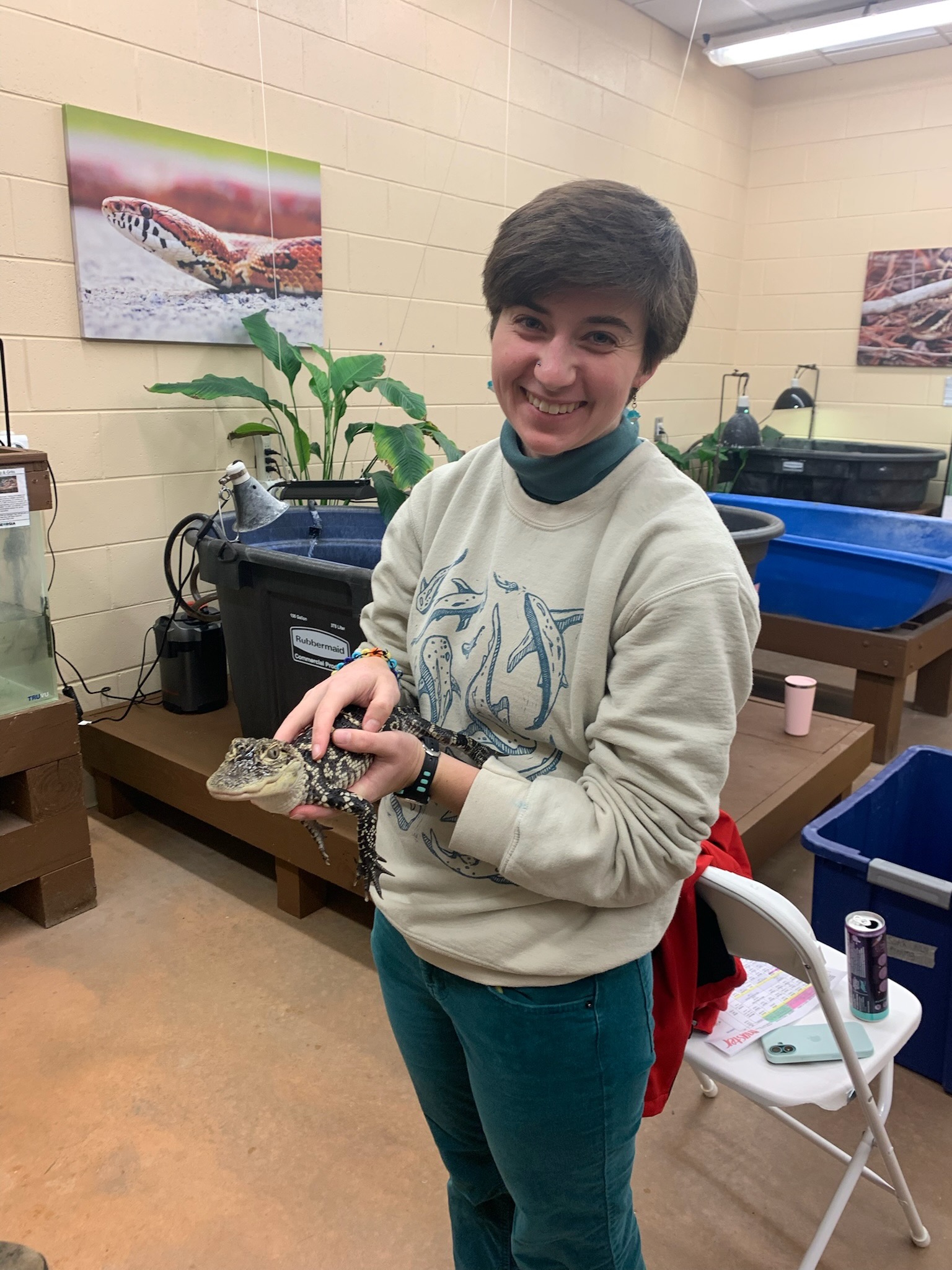
One of the many strengths of the Marine Education Fellowship is that it affords fellows the opportunity to experience a little bit of everything. The other fellows and I jumped almost immediately into a rotation schedule that had us teaching pre-K–12 programs, practicing aquarium husbandry, and delivering outreach programs to schools across the county. I was able to develop skills I hadn’t expected the fellowship to touch on: managing budgets, driving Carolina skiffs, power washing oyster cages, identifying phytoplankton. Most importantly, I was always learning something new. No two courses looked the same; even when I wasn’t reading about Georgia’s coast, writing outlines, or shadowing a class, I was experiencing something novel and exciting on the job.

Through the fall, professional staff also encouraged each of us to develop a fellowship project on any topic of our choosing. Curious to learn more about a subject I had little prior experience in, I decided to research the ways in which Indigenous knowledge is currently interwoven with conservation education. When my research yielded fewer results than expected, I conducted an interview project with educators in Georgia to ask them directly about ways they reference Indigenous and Western ecological knowledge in their content and teaching methods. I shared this knowledge with our teaching staff and volunteers through a presentation and a collection of resources, currently housed in the white binder atop my desk.
Despite months of research, I have barely begun to scratch the surface of an area of work almost entirely new to me. There are already people building environmental education that prioritizes Indigenous sovereignty, that calls for collaboration in deciding not just what content is relevant, but how that content is taught. It is my hope that, through the rest of my fellowship and beyond, I will continue to carry on this work.
Much like my desk, I have found that this fellowship has asked me to draw simultaneously on the past, present, and future to become an effective educator. My personal and professional experiences, current body of knowledge and expertise, and hopes for the future of conservation education all become necessary tools as I foster my students’ curiosity and resilience. This non-linearity reminds me, past, present, or future, that learning is borne of wonder. It is with new wonder that I approach whatever may come next.