Before I ever stepped into a research lab, my interest in food science was shaped by my family’s pizza business. Growing up around frozen food production sparked my curiosity about how food systems work, even if I didn’t fully understand the science behind them at the time. Freezing seemed simple, just another step in the process.
Now, as a graduate student in Food Science at the University of Georgia and a Marine Extension and Georgia Sea Grant Research Trainee, I’ve come to realize that freezing is far more complex than it appears. My research focuses on developing collagen peptide powders from cannonball jellyfish and evaluating their potential to improve the quality of frozen foods.
One of the biggest challenges in frozen food systems is something most people never see: ice crystals. As food is stored and exposed to slight temperature changes, small ice crystals grow into larger ones, damaging texture and quality. This process, known as recrystallization, is why ice cream can become grainy or why frozen foods lose their original structure over time.
In nature, however, some marine organisms have already solved this problem.
Certain species produce antifreeze proteins that allow them to survive in extremely cold environments by slowing or preventing ice crystal growth. Inspired by these natural systems, my research explores whether jellyfish-derived collagen peptides can mimic similar effects in food applications.
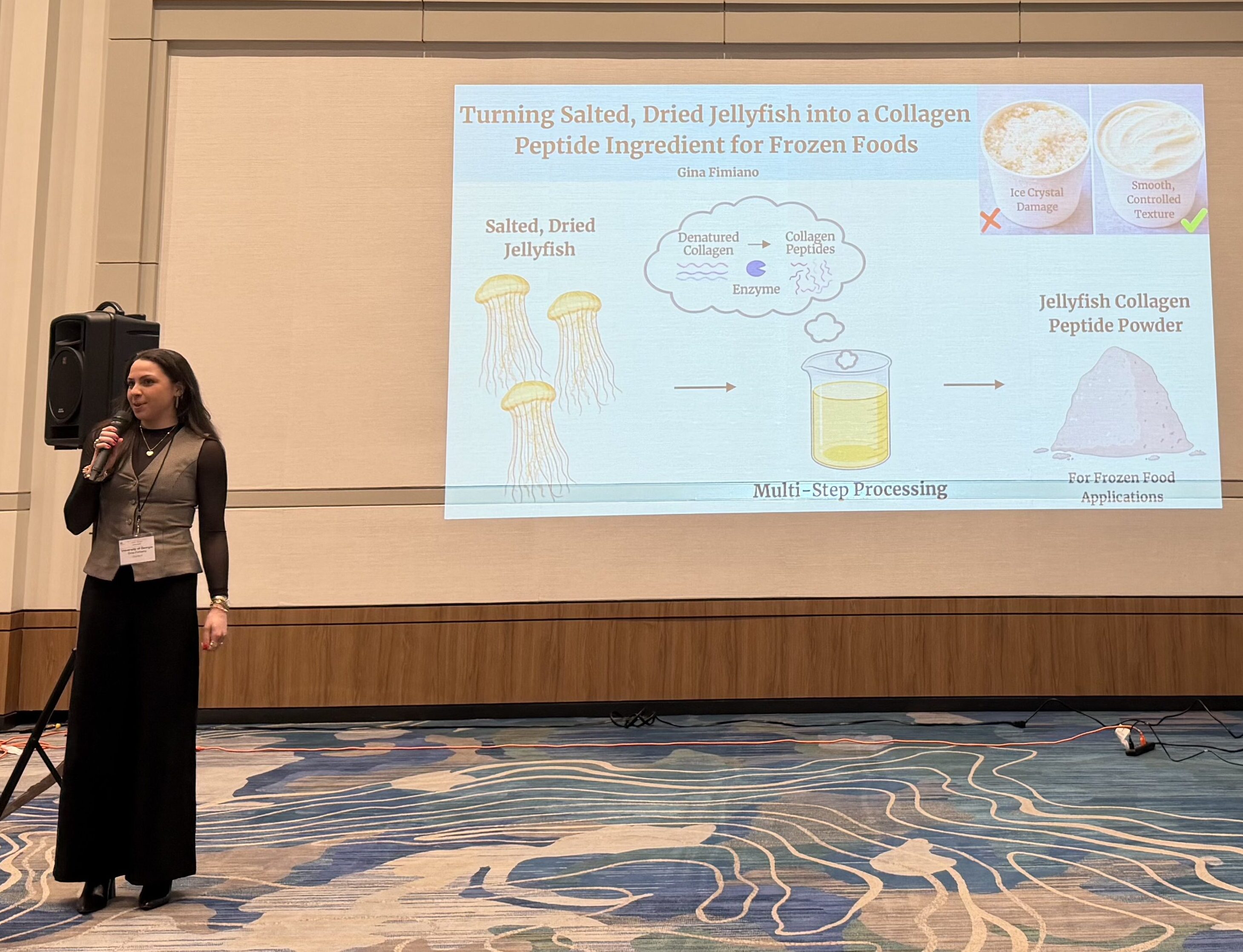
Through my work as a Marine Extension and Georgia Sea Grant Research Trainee, I’ve investigated how different processing techniques affect the functionality of these peptides. By adjusting how the material is processed and purified, I evaluate how these changes impact their ability to control ice crystal behavior. This work contributes not only to improving the quality of frozen food but also to developing more sustainable uses of marine resources right here in Georgia.
What has surprised me most is how interconnected this research is. It brings together marine science, food processing, chemistry, and real-world industry challenges in a way I hadn’t fully appreciated before. It has also pushed me to think beyond the lab and consider how scientific research can translate into practical solutions that people experience every day.
Looking back, it feels like a full-circle moment. What began as an early curiosity sparked by my family’s pizza business has evolved into research focused on improving frozen foods at a molecular level. Through Marine Extension and Georgia Sea Grant, I’ve had the opportunity to connect those early influences with my current work and contribute to something larger than I initially imagined.
I never thought I would be working with jellyfish, or that they might be processed into an ingredient that can help solve one of the frozen food industry’s most persistent challenges, and I am incredibly thankful to Marine Extension and Georgia Sea Grant for making this journey possible.

Marine Extension and Georgia Sea Grant’s Research Traineeship is a year-long, funded opportunity where students tackle their own projects under the guidance of a faculty mentor. Learn more at https://gacoast.uga.edu/research-traineeship/.