I am a master’s student at Georgia Southern University, and I’m part of the Freshwater Ecology Laboratory. My thesis project, which is funded through a Marine Extension and Georgia Sea Grant Research Traineeship, explores how saltwater is moving into historically freshwater habitats on Sapelo Island and impacts the processes and life that are found in them.

I first got involved in this project when I joined Georgia Southern as part of the REU (Research Experience for Undergraduates) program during the summer before my senior year at Oglethorpe University in Atlanta. As an REU student, I was mentored by Raymond Kidder, a master’s student at Georgia Southern, who was conducting this same line of research on the island. I was tasked with helping him in the field, as well as developing and running a laboratory experiment of my own. This experiment took freshwater isopods and small dried leaf discs and placed them in tanks with varying salt concentrations to measure how these invertebrates and the important process of decomposition are affected by the salt. We did see negative impacts, and this project is currently on track for publication in a scientific journal. I enjoyed this project and the fieldwork greatly and decided to rejoin the lab as a master’s student to fuel my childhood passion for aquatic biology and continue the work that was started.
Sapelo Island is a great model system for studying the effects of saltwater intrusion because an artificial network of channels was dug out for agriculture back in the 1800s, but its decline allowed tides to push water inland. This has been a problem recently for the small number of people living on the island because of flooding and culturally significant crop damage. On top of these community impacts, living things inhabiting these habitats are at risk because many of them cannot tolerate salty water. Conditions may worsen as sea level is expected to rise, along with the more frequent and severe storms, both of which can move lots of salt inland.
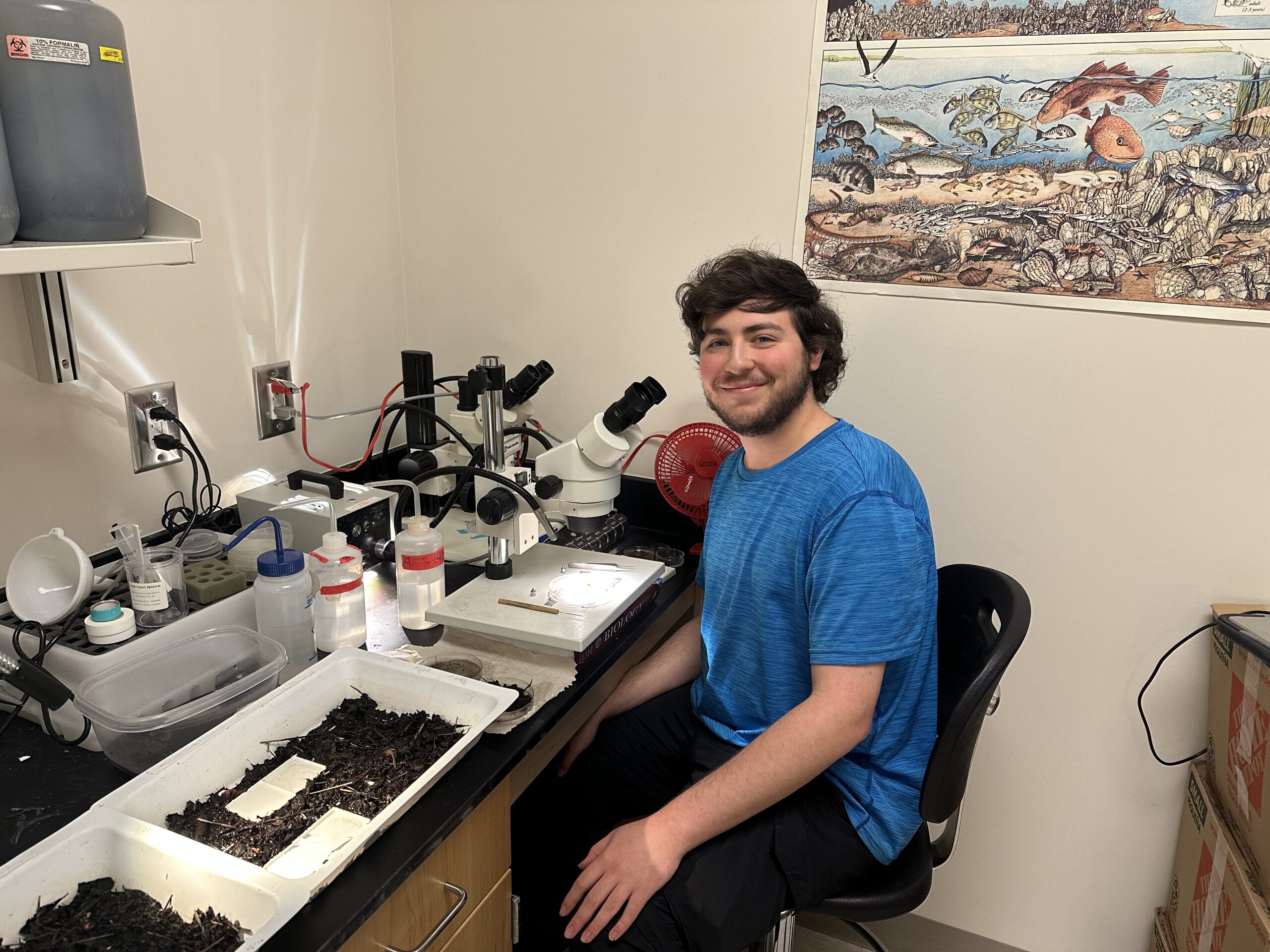
For my study, I’m including an artificial channel site that can serve as a freshwater reference to compare to sites that experience intrusion. I’m also looking at what is occurring in wetlands that do not have a connection to these channels because these areas make up a majority of the freshwater habitats on the island. This project has several components to study habitat health and function. I’m using nets to collect macroinvertebrates, or bugs, at each site seasonally to determine what groups can survive in salty conditions and how much diversity there is.
Current results do show more diversity and more intolerant organisms in freshwater, indicating better conditions. We are also seeing more crayfish and amphibians in these freshwater habitats, and estuarine fish at the site that is highly impacted by intrusion, all of which were caught by mesh traps. Each month, I am also looking at how the breakdown of organic matter (leaves) is affected which is an important process by which many organisms rely on for food. The artificial channel sites also contain continuous data loggers for depth and conductivity (salt levels) to monitor any trends between tides and storms.

This project started in May 2024, and will conclude in April 2025, after which I will be completing my thesis. I have been able to share this research at a couple conferences, including the Southeastern Estuarine Research Society meeting and the Georgia Water Resources Conference. I will also be presenting this work at the Society for Freshwater Science meeting in May. In April, I’m leading one of Marine Extension and Georgia Sea Grant’s public program, “Saltwater Science Series: Wetlands,” which will focus on sharing my research with the community and engaging them in hands-on data collection at a freshwater wetland on Skidaway Island. Additionally, another outreach event for the Sapelo Island community will be held later in the month. My research and the ability to network with others at conferences or outreach programs would not have been possible without support from other researchers at Georgia Southern as well as partners at Sapelo Island National Estuarine Research Reserve. I look forward to publishing this work and continuing to share findings with coastal communities in hopes of better understanding how to address impacts of saltwater intrusion on freshwater habitats.